What to buy for your recovery and your newborn: a UK checklist with quantities
Maternity pads, nursing bras, nappies, sleepsuits, a car seat and the rest: what you need for the first six weeks, how many, where to buy them in the UK, and what you can skip.
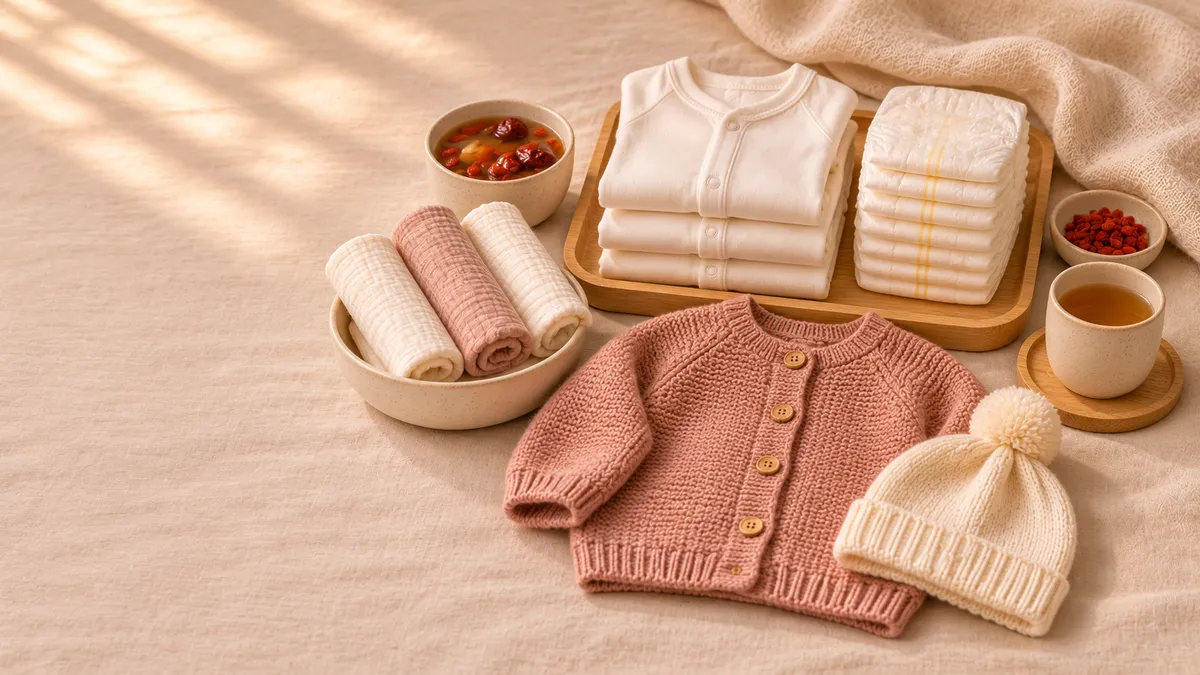
Shops will happily sell you a whole nursery, but a newborn needs surprisingly little, and so does your recovery. This checklist covers the first six weeks, which takes in the confinement month (坐月) and runs up to your 6-week postnatal check. Quantities follow the NHS lists where it gives them, and otherwise what most families find they use.
For the food side of the month, see our confinement shopping list.
When to get ready
- By about 32 to 34 weeks: buy the big items (car seat, Moses basket or cot, pushchair) so there's time for delivery and to practise fitting the car seat.
- A few weeks before your due date (many people aim for 36 weeks): pack your hospital bag, even if you're planning a home birth, and have the first week's supplies at home.
- After the birth: top up nappies, pads and breast pads as you learn what you actually use. Online deliveries save a trip.
You don't need everything new. Borrowed and second-hand clothes, baths and pushchairs are fine. The NHS says the two things to buy new are the cot or basket mattress and the car seat: you can't be sure a used car seat hasn't been in an accident.
For your recovery
| Item | How many | Where to buy |
|---|---|---|
| Maternity pads (super-absorbent) | 2 packs in your hospital bag, and 4 to 6 more at home | Supermarkets, pharmacies |
| Knickers: big, cotton or disposable | 5 or 6 pairs in your bag; about 10 in total | Supermarkets, pharmacies, clothes shops |
| Nursing bras, or soft bras | 2 or 3 | Department stores, supermarkets, online |
| Breast pads | 1 or 2 boxes of disposable, or 3 or 4 pairs of washable | Supermarkets, pharmacies |
| Nightwear that opens at the front | 3 or 4 sets | Clothes shops, supermarkets |
| Loose, high-waisted bottoms (after a caesarean) | 2 or 3 | Clothes shops, supermarkets |
| Painkillers | 1 pack | Pharmacies: ask which suit you while breastfeeding |
| A jug or squeeze bottle, for warm water while you pee | 1 | Pharmacies, online, or any jug |
| A large water bottle | 1 | Anywhere |
| Vitamin D, 10 micrograms a day | 1 pot | Supermarkets, pharmacies; free with Healthy Start |
- Pads, not tampons. Bleeding after birth (lochia) can last 6 to 8 weeks. The NHS advises pads rather than tampons until after your 6-week check, because tampons can raise the risk of infection while you heal. Once the bleeding is light, ordinary pads are enough.
- Too much bleeding: if you're soaking a maternity pad every 1 to 2 hours, contact your midwife or maternity unit. Our guide to your body after birth lists the warning signs.
- Optional extras: a nursing pillow, nipple cream, or a support band for your tummy. If you've had a caesarean, ask your midwife before using a support band.
Keeping warm in the confinement month
Many families keep the tradition of staying warm and out of draughts. Useful things:
- A hairdryer, so you can wash your hair and dry it straight away. The NHS advises a daily bath or shower, and nothing in NHS guidance says to avoid washing your hair. See what 坐月 is.
- A warm dressing gown, slippers with grip, and socks.
- A thermos flask for warm drinks within reach while you feed.
Keep yourself warm, but not the baby: newborns overheat easily. More on this below.
For the baby
Nappies and changing
| Item | How many | Where to buy |
|---|---|---|
| Newborn nappies (size 1), disposable or cloth | 2 or 3 packs to start | Supermarkets, pharmacies |
| Cotton wool, or unscented, alcohol-free wipes | 2 or 3 bags or packs | Supermarkets, pharmacies |
| Barrier cream | 1 tube | Supermarkets, pharmacies |
| Changing mat, or a towel | 1 | Baby shops, supermarkets |
- Don't stock up on size 1 nappies: many babies move up a size within a few weeks.
Clothes
| Item | How many | Where to buy |
|---|---|---|
| All-in-one sleepsuits | At least 6 | Supermarkets, clothes shops, second-hand |
| Vests or bodysuits that fasten under the nappy | 4 to 6 | Supermarkets, clothes shops |
| Cardigans, wool or cotton | 2 | Clothes shops |
| Scratch mittens, socks or booties | 2 or 3 pairs | Supermarkets, clothes shops |
| A hat | 1, for outdoors in cold weather | Supermarkets, clothes shops |
- Buy mostly newborn and 0 to 3 months sizes. Babies outgrow newborn sizes quickly, and gifts often arrive in bigger sizes.
Sleeping
| Item | How many | Where to buy |
|---|---|---|
| Moses basket, crib, carrycot or cot | 1 | Baby shops, online |
| A new, firm, flat, waterproof mattress that fits with no gaps | 1 | Baby shops, online |
| Fitted sheets | At least 4 | Baby shops, supermarkets |
| Baby sleeping bags, or sheets and cellular blankets | 2 | Baby shops, supermarkets |
| A room thermometer | 1 | Baby shops, pharmacies, online |
- Nothing else in the cot. Leave out pillows, duvets, cot bumpers, soft toys, sleep positioners, pods and nests. They raise the risk of suffocation and sudden infant death.
- Keep the room at 16 to 20°C, and don't put a hat on your baby to sleep indoors. Our guide to safe sleep for newborns has the details.
Feeding
If you're breastfeeding, you don't need any equipment to start. Your midwife or health visitor can help if you later want a pump.
If you're feeding with formula or expressed milk:
| Item | How many | Where to buy |
|---|---|---|
| Bottles and newborn teats | About 6 | Supermarkets, pharmacies, baby shops |
| A bottle brush and a teat brush | 1 each | Supermarkets, pharmacies |
| A steriliser: steam, cold-water tablets, or a large pan for boiling | 1 | Supermarkets, pharmacies, baby shops |
| First infant formula | 1 tub or a box of ready-made bottles to start | Supermarkets, pharmacies |
- Sterilise all feeding equipment until your baby is at least 12 months old. Wash it in hot, soapy water first.
- First infant formula is the only formula a baby needs for the first year, unless a health professional advises another kind.
- If you're breastfeeding, see our guide to breastfeeding in the first weeks.
Bathing and health
| Item | How many | Where to buy |
|---|---|---|
| A baby bath, or a clean washing-up bowl | 1 | Baby shops, supermarkets, second-hand |
| Soft towels | 2 or 3 | Anywhere |
| Cotton wool | 1 bag (shared with changing) | Supermarkets, pharmacies |
| A digital thermometer (for underarm use) | 1 | Pharmacies |
| Baby nail file or round-ended scissors | 1 | Pharmacies, supermarkets |
| Vitamin D drops for babies (8.5 to 10 micrograms a day) | 1 bottle, if breastfeeding | Pharmacies, supermarkets; free with Healthy Start |
- Plain water for the first month. The NHS says plain water is best for a newborn's skin, so don't use liquid cleansers or add bath products.
- Vitamin D: the NHS recommends daily drops from birth for breastfed babies. Babies having more than 500ml of formula a day don't need them.
Going out
| Item | How many | Where to buy |
|---|---|---|
| A rear-facing infant car seat, bought new | 1 | Baby shops, which can usually check the fit in your car |
| A pushchair or pram with a seat that lies flat | 1 | Baby shops, online, second-hand |
| A changing bag | 1 | Anywhere; any roomy bag works |
| A sling or carrier | Optional | Baby shops, sling libraries |
- The car seat is the law. Babies must travel in a suitable child car seat in a car, including the trip home from hospital. Check it suits your baby's weight or height and your car.
What you can skip
- Cot bumpers, pillows, duvets, sleep positioners and baby nests. They aren't safe for sleep.
- Baby toiletries for the first month. Plain water is best.
- A changing table, a nappy bin, bottle warmers and baby shoes. Nice to have, but not needed.
- Lots of newborn-size clothes. A handful is enough.
Help with costs
- Healthy Start: if you're more than 10 weeks pregnant or have a child under 4, and you get certain benefits, you may get money on a card for milk, fruit and vegetables, and free vitamins for you and your baby.
- Sure Start Maternity Grant: a one-off £500 payment towards the costs of a first baby (or of twins or more) if you or your partner get certain benefits. It's for England, Wales and Northern Ireland. Scotland has the Best Start Grant instead.
- Local baby banks and parent groups often have good second-hand clothes and equipment. Your health visitor can point you to one.
Sources
- NHS Best Start in Life — What to buy for your newborn baby
- NHS Best Start in Life — Hospital bag checklist
- NHS — Your body after labour and birth
- NHS Best Start in Life — Bathing your baby
- NHS — Sterilising baby bottles
- NHS — Vitamins for children
- The Lullaby Trust — Safer sleep advice
- GOV.UK — Child car seats: the law
- GOV.UK — Sure Start Maternity Grant
- NHS — Healthy Start
- GOV.UK — Public funds
Disclaimer
- Our articles are general information only. They are not medical, legal or other professional advice, and they don’t replace advice from your midwife, health visitor, GP or another qualified professional who knows your situation.
- Postnatal Link is not a healthcare provider. Carers on Postnatal Link offer practical postnatal support; they don’t replace your NHS midwife, health visitor or GP.
- We check articles against NHS and other official UK sources at the time of writing, but guidance changes. Check the latest advice, and never ignore professional advice or delay getting help because of something you read here.
- Traditional confinement practices and foods are described as cultural information, not as health claims.
- Links to other websites are provided for information; we aren’t responsible for their content.
- In an emergency call 999. For urgent medical advice call NHS 111 or go to 111.nhs.uk.
Keep reading

Your body after birth: what's normal, and the signs that need help
Bleeding, afterpains, stitches, a caesarean wound, tiredness and emotions in the weeks after birth — what to expect, how to look after yourself, and when to call your midwife, 111 or 999.

Baby blues or postnatal depression? Looking after your mind after birth
How to tell the baby blues from postnatal depression, why it's common and nothing to be ashamed of, the rare emergency of postpartum psychosis, and where Hong Kong families in the UK can get help.
Your confinement shopping list: what to buy, how much, and where to find it in the UK
A month's worth of dried goods, fresh food and kitchen kit for 坐月, with suggested quantities, where to buy each item in the UK, and when to start.